













By Padma Krishnan
“Go to the other mound, there is a skeleton,” a family on their way out tells me, as I stand baffled at the entrance of the archaeological site of Rakhigarhi, unsure of where to begin. Spanning over 350 hectares, this is the largest metropolis of the Indus Valley Civilisation (IVC), and it is a lot to explore on foot.
Flourishing along the Indus River, the IVC was contemporary with two other river valley civilisations, the Nile in Egypt and the Euphrates and Tigris in Iraq. Spanning from 3300 to 1300 BCE, it had its golden age between 2600–1900 BCE. While the Egyptians were building the great pyramids and the Mesopotamians were developing writing, the Harappans from the Indus Valley were building grid-patterned cities with community baths, water reservoirs and drainage systems. Unlike the other two civilisations, they did not leave colossal monuments dedicated to rulers or gods, and the Indus script is still undeciphered, even after almost a century of research.
Stretching over parts of Afghanistan, Pakistan and northwestern India, the Harappans developed five major urban centres:
Mohenjo-daro, Harappa, and Ganweriwala in Pakistan, and Dholavira and Rakhigarhi in India. Situated in the Ghaggar-Hakra river plain of the Hisar district of Haryana, Rakhigarhi comprises two villages, Raki Shahpur and Rakhi Khas. Excavations began in 1969 and continue today. Findings show that this vast area was inhabited from the early Harappan (3200-2700 BCE) to the Mature Harappan (2700-1800 BCE) periods. The settlement reveals sophisticated urban planning: grid-patterned drainage systems, communal granaries, burial grounds, and houses built repeatedly like layers of a wedding cake.
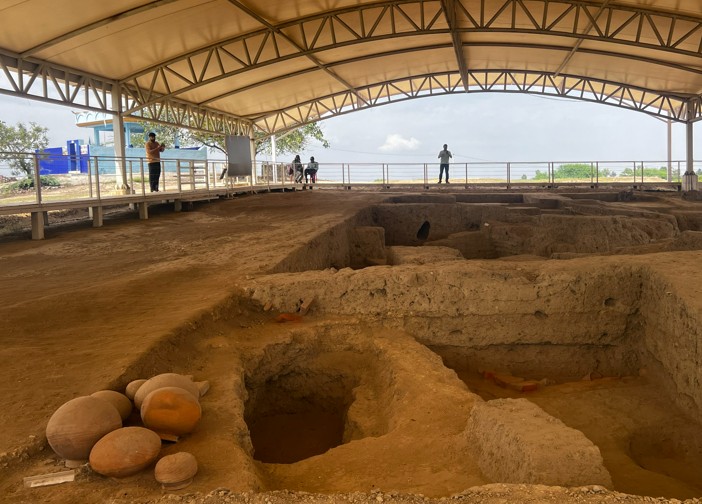
Peering into one of the yawning pits, the dig worker points to two types of bricks in the walls: the burnt bricks and the mud bricks. The sizes are bigger than what is in use now. Someone in the crowd says, “We had the same large burnt bricks in my ancestral house.” The presence of two distinct types of bricks suggests social stratification. I wonder who lived where, and did they ever cross over?
Walking around the mounds where active digging is underway, you can find the famed geometric patterns, drainage, and water harvesting systems. They are spread uniformly across the vast area, demonstrating centralised planning and standardisation of construction. If you wander into the neighbouring village, you can still see the same patterns of bricks and drainage systems. The ancestral lifestyle continues as oxen pull carts along dusty roads and water buffaloes, known locally as ‘black gold’ for their milk yield, wade through ponds. In nearby Rajasthan, women still wear thick bangles identical to those unearthed here, though plastic has replaced bronze and terracotta. The excavations point to extensive lapidary and the presence of skilled craftsmen among the inhabitants. Interestingly, bead work is still practiced among tribal communities.
Many of the artifacts found here are now housed in the National Museum in New Delhi, but you can still find samples of them in the onsite museum. On display are standardised bricks, weights, measures, and terracotta jewellery, pots and the skeletal remains of someone who walked these streets 4,600 years ago.
Timing matters here. On the day of my visit, one of the supervisors excitedly tells me about the day’s discovery of an ancient bronze cup. There are potsherds and other findings spread on the ground while they are categorised and documented. You also encounter the skeletons at the centre of the ongoing DNA debate about the ancestry of a billion people.
For travellers, Rakhigarhi offers a unique experience of witnessing archaeological excavations in real time. Unlike the towering temples, formidable forts and fabled marble wonders of India, ancient settlements like Rakhigarhi force one to peel back the layers of the past and look deeply into another world. The exposed skeletons at Rakhigarhi, and the one housed in the glass casket in the museum, and the unclaimed jewellery and pots become memento mori for me, their stillness a reminder of the fleeting nature of individual lives and great civilisations.
Traveller’s Notebook
The trip: Rakhigarhi is not on a tourist circuit. It is 170 km from the national capital New Delhi and about 60 km from Hisar town, which is connected by air, road and train. For an enjoyable trip, get a taxi or drive yourself.
When to Go: Visit between September and March and you’ll witness active digs. During monsoon season, the excavation pits are covered and inaccessible. Summer heat (April-June) makes outdoor exploration punishing.
Preparation: Dress comfortably, wear walking shoes and carry a cap or an umbrella. There are no restaurants or snack shops adjacent to the mounds; plan to stop for meals at the excellent options along the national highway.
© Padma Krishnan, 2026